2/13/10

Fixing the Olympics

The 2010 Winter Olympics open tonight in Vancouver. You are excused if you are either unaware or uninterested in this worldwide event. There is no argument that the Olympic movement is a fantastic force for global unity, sportsmanship and hope (as well as terrible fashion). From the inception in ancient Greece, to the current form, our lives have all been improved by the workings of the Olympics. As our world grows further connected, it is less interesting to see mixed walks of life competing in the same arena. We have channels now that show these sports all year round which makes some of the events less interesting. Time for the International Olympic Committee (IOC) to take a step back and head off some problems before they present major obstacles for continuing success.

I still love the Olympics (as millions of others do to, the ratings are still outrageous) and I will watch as much as possible these next two weeks. Some changes are sorely needed, however, to make these events better. Luckily, I have some suggestions (You listening, Jacques Rogge?)

1.) Settle on the lineup

At the heart of the Olympics are the sports, without them we have nothing. So it would make sense that we get the list of events settled before fixing anything else (drug testing being the possible exception). The IOC is responsible for approving the official list of sports. Not surprisingly, there have been many, many changes over the years including the additions and subtractions of well known events. For example, baseball and softball were removed from the Summer games moving forward after 2008 (Sadly, we also have to now live without tug of war being in the games). To make everything as successful as possible, it will require a process of removing some events in addition to switching others between Summer and Winter.


Share/Save/Bookmark

KGB: A Study in Non-Rational Behavior


While watching the Super Bowl last week, the following commercial from kgb (Yes, they keep the company name lower case, I immediately do not like them). My friends and I are all 22 and 23 year olds so we were familiar with the service they provide. In brief, kgb takes text message questions (Any question) and provides an answer, at a cost of $0.99. A couple of months ago, a few of us were at a bar without an wireless connection and we needed an answer. This gave us a chance to see if this kgb thing worked. They came through. The service works just as described with a quick, precise answer being provided immediately (We needed to know what was the name and age of the Dos Equis Most Interesting Man in the World). Worked like a charm; never even considered using it again. This led us to this question on Sunday, how exactly could kgb make enough money to support a Super Bowl commercial (going rate of $3 million)? We are headed towards a world in which we will always be connected to the internet. Most phones released now have some sort of connection and these are only providing a more complete, full functioning experience. Networks are getting faster and covering a larger area. It would seem like now would be the worst time to push a service like kgb. Let the investigation begin.

First thing I didn't know about kgb: it is an acronym (Knowledge Generation Bureau). Please do not confuse it with the real KGB, the Soviet intelligence unit, as this may lead to some problems. Problems involving your "disappearance" in the middle of the night, if you get my drift. While kgb is the name of the company, it is not the center of the business. I'll let the official summary from the kgb website explain their structure (highlights added):


Share/Save/Bookmark

2/10/10

How Much is Too Much?

How do you consume your news and information?
Has this changed in the last year/three years/decade?
Do you feel overexposed?

I am inclined to think that the responses to these questions will be all over the place. Personally, I consume news in almost all of its forms; the way I consume changes on an almost weekly basis; and yes, I do feel a bit overexposed to it all. 

Almost since my first time logging on to the World Wide Web (I miss calling it that), I have been searching for my comfort zone in terms of taking in the details of the world around me. The problem is news outlets are a shape shifting mass which does not allow you to put it in a defined area (much like the Smoke Monster in Lost or B.O.B from Monsters vs. Aliens). One quick example: less than a year ago, no one was Twitter-ing. Today every anchor, outlet, blogger and man on the street has a Twitter handle. Even if you had found your style of consumption and were comfortable with how it worked, you are now faced with this new medium. The Twitter value debate is one for another day, but it is impossible to say there is nothing missed by not being on Twitter. There are simply ideas and trends which explode on Twitter and do not make it to the mainstream media (or it takes a different shape or is delayed. Remember when the Tiger Woods story hit over Thanksgiving? Twitter was the first to know).


Share/Save/Bookmark

A World Without Mirrors

I have been fascinated by mirrors for a great time now. Not that I am alone, the mirror has been the focus of various movies, books, songs, etc. The concept of seeing into a device which shows some sort of "alternate world", which is in fact reality, is borderline psychedelic. It is not until you start to actually think about mirrors that they become more than background noise. Once you have wrapped yourself around the idea of a mirror, take the next step and imagine the world with no mirrors. Yikes.

To make this quick journey, we must first understand what we are talking about. Almost monthly I ask myself the same question and then always fail on the followup research. What exactly is a mirror (and no need to get smart, I mean how does it work)?  It is not a material that naturally occurs. There are no Great Mirrored Plains in Togo (we can wish, though). No Mirror Canyon. No Mirror Lake (oh, wait, yes there is, but that's different). So what are mirrors and how do we make them? It is really an unbelievable concept if you step think about it. Man has created a substance which can create a true reflection of himself. Wow. Good job early generational people (and, no, I'm not counting you cheaters who put water in a bowl to create a reflection, I'm talking real, manufactured mirrors). This is no history or science lesson, so as to not bore anyone a mirror is simply glass coated in reflective substance which sends light, and more importantly the image, back at its viewer (for much, much more, enjoy). 


Share/Save/Bookmark

Grammy's 2010

Just some random thoughts and questions which came to mind watching the 52nd Grammy Awards

  • Opening Performance with Lady Gaga featuring Sir Elton John
    • Lady Gaga seems to be in a battle with Beyonce to who can show the most vaginal cleavage
    • Lady Gaga has become the go-to performer of our time right now. She may not have the best songs or the most lyrically pleasing voice and she is certainly not the best piece of eye candy, but whenever she performs, no one looks away.
    • I love the fact that Lady Gaga does not worry about looking good. She can be covered in ash or blood on a major broadcast without a care. Simply interested in the performance.
    • Elton John hasn't lost a step and continues to be the homosexual spokesman musically. There seemed to be an honest mutual respect between the two performers.
    • Couldn't help but think back to Elton's performance with Eminem. Whenever he makes an appearance it has both musical and social importance.

  • Stephen Colbert
    • Never changes his style not matter the performance. This is what makes him great. Whether it is the White House Correspondents Dinner or doing a tour of Iraq, he plays his character perfectly. The iPad segment was the funniest moment of the night by a large margin.

  • Song of the Year
    • The way I understand it Song of the Year is for the writing of the song. If this is true then how does "Single Ladies (Put a Ring on It)" win? 
    • A quick excerpt: 
      I got gloss on my lips, a man on my hips
      hold me tighter than my Dereon jeans
      acting up, drink in my cup
      I couldn't care less what you thin
      k

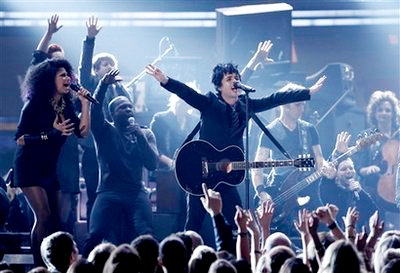
  • Green Day performance 
    • Coming soon to Broadway: Green Day's American Idiot! Oh, wait, scratch that exclamation mark. This is nothing to be excited about. What would "Dookie" Green Day think of what we saw here tonight? For shame. 

  • Best Country Album 

  • Beyonce performance: 
    • Doing her best Marilyn Monroe impression, which is nice and all, but did we need the crotch grab? 
    • Rhianna wants her rated-r look back. 
    • Do you think that guy who was lifted up by Beyonce's touch and then pushed down happy with his career? 
    • Enjoyed the mash up of "If I Were a Boy" and Alanis Morissette's "You Oughta Know". Girl power!

  • Good to see Seal again

  • Pink 
    • At first I was disappointed because we all saw this Cirque Du Soleil performance at the MTV Awards months ago, but this was much better. This incorporation of the acrobatics was much more genuine and actually added to the aesthetics of the song. The MTV Award performance felt more like a gimmick, this was special.

  • Best New Artist 
    • I have a problem with this category. How exactly do you qualify as a "new artist"? MGMT's critically acclaimed album "Oracular Spectacular" was released in January of 2008. The Silversun Pickups has their first hit on the charts in 2007. To make things worse, neither of these two won. Instead, a band fronted by Kevin from last season's Top Chef took home the award. Madness!

  • Black Eyed Peas performance
    • Thank you for showing us what Muslim women will look like in 20 years (no image available, but check out the back up dancers). 
    • I like to look a current songs and think about what their Oldies chances are. Do you honestly expect the song to be played on 2000's radio in 25 years? It is usually a toss up, but "I've Got a Feeling" is simply a wonderful pop song which will have us dancing for years.

  • Lady Antebellum 
    • Good job Grammy producers, nothing kills the energy from the Black Eyed Peas' performance quite like a slow jam from Lady Antebellum

  • Best Comedy Album
    • I bet Patton Oswalt is embarrassed to be included in a category with Kathy Griffin, Weird Al and George Lopez. Good win for Colbert.

  • Don't know why it sounded strange, but I expect Ringo Starr to be introduced as something different than just "multiple Grammy winner".
 
  • Record of the Year:
    • Happy for Kings of Leon and their omnipresent song "Use Somebody". Even happier that one Followill family member stayed sober enough to give a somewhat understandable acceptance speech

  • Jamie Foxx performance
    •  I'm gonna blame this entire performance on the alcohol. It seems like the idea was put together by Girl Talk, too many jumbled songs put together

  • Ke$ha seemed thrilled to be presenting with Justin Beiber
 

  • Best Rock Album 
    • Green Day wins, but it's kinda like when Gonzaga wins the WCC. The other nominees included a Clapton Live album and AC/DC!?

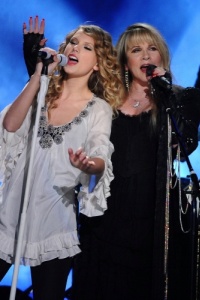
  • Taylor Swift
    • I'm sorry, I am not a Taylor Swift hater, but Stevie Nix will always swing circles around her. This pairing made Taylor seem out of her league. It's gotta be a great feeling to have a legend sing one of your songs, though.

  • Smokey Robinson, Celine Dion, Usher, Jennifer Hudson, Carrie Underwood  perform Michael Jackson's "Earth Song" 
    • So this is what 3D TV will be like? Thanks for the headache CBS. You can take me off the pre-order list.

  • Michael Jackson's kids on the Grammy's 
    • My brain just exploded. I can't imagine what those kids have been through. Had to watch it a couple times just to wrap my head around it. The whole thing gave me a creepy Olsen twins vibe. This is not the last we have seen of these two. 

  • Bon Jovi performance
    • I demand an explanation as to why we have been cheated out of years of Bon Jovi Grammy performances? 2010 and they make their first appearance? This is inexcusable. They sure made up for it with what felt like a 20 minute set in which they sounded much more country than Taylor Swift. 
    • "Living On a Prayer", what a fantastic pop song?

  • Rap/Sung collaboration
    • 1.) This is a category? 2.) "I'm On a Boat" was nominated for a Grammy? 3.) Can't decide which is more confusing.

  • Dave Matthews Band performance 
    • Dave reminds me of Tom Hanks. Not only in terms of looks, but in terms of professionalism. Any chance the band gets to play they are consistently entertaining and bring something to the show.
    • Also good to see Ruben Studdard got a job again in the horn section (check out the video when it is posted).


  • Best Female Vocal Performance: 
    • Beyonce wins for "Halo". It is her year, as proclaims the National Academy of Recording Arts and Sciences. 

  • In general, I am a sucker for montages. For some reason if you put pictures or video to a coordinated set of music, I will watch and be enthralled. The Grammy "In Memoriam" is, for the most part, a very classy part of the show. I cannot understand, however, when people clap for certain people who have passed away. It turns into a high school pep assembly with the most popular kids vying for the most crowd reaction. It's sad that all those honored could not just have their moment in silence from the crowd.

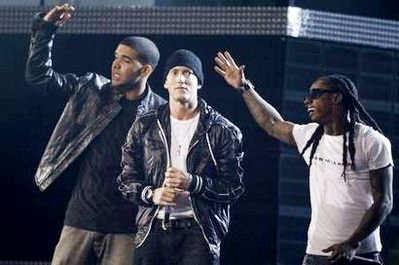
  • Eminem, Drake and Lil Wayne performance featuring Travis Barker on drums 
    • I am not generally a fan of rap performances, let alone an ensemble performance. I find that most often these regress to sloppy mixes of verses and choruses with the rappers going from one side of the stage to the other. Not much going on and the lyrical stylings are not crisp. That's why this performance blew me away. It doesn't hurt that Eminem and Lil Wayne are probably the best lyricists right now, but the x-factor was Drake. Wrapping the entire performance around his song gave structure to the other performers. Drake has his moments and he hit his points well, but it did seem as though he was deferring to his elders. I would have argued this was the best performance of the night if only I could have heard all of it. CBS chose to silence more of the words than I can remember. Maybe the Eminem and Lil Wayne were not laying off the explicit content, but it did take away slightly from the flow of the performance. For those at the event, I would imagine it was amazing.
    • Travis Barker is the coolest guy in music
    • Quentin Tarantino is the lamest guy in entertainment, he tried way too hard during his introduction of the performance.
    • Loved Lil Wayne's t-shirt which proclaimed that we should all "LISTEN TO LIL WAYNE"

  • Album of the Year
    • Nominees
      • "I Am...Sasha Fierce", Beyonce
      • "The E.N.D.", the Black Eyed Peas
      • "The Fame", Lady Gaga
      • "Big Whiskey and the Gru Grux King", the Dave Matthews Band
      • "Fearless", Taylor Swift
    • I thought this was a three person race. Dave Matthews Band was thrown in to satisfy the rock contingent, but had no chance of winning. The E.N.D produced a few hits, but was not as strong as "Elephunk". In third place, I thought Taylor Swift would not win. She wrote a wonderful album and was a bright star in the otherwise sad young, overproduced star landscape (which includes the Jonas Brothers, Miley Cyrus and their ilk). But this is a grown up category featuring two clearly superior albums. 
    • What will we remember 2009 as in main stream music? Who was in our social conscience more often? Who shaped the radio and Internet music streams in a greater way?
    • I argue Lady Gaga did more this year than any other artist and the songs from "The Fame" dominated our ears. Others could argue their case for Beyonce. 
    • The Winner? Taylor Swift. Everyone likes a fairytale, whether the ending fits or not. 

GRM for RAL


Share/Save/Bookmark

Depp & Burton

With the upcoming March release of the Disney 3D version of Alice in Wonderland, we are yet again witness to a Tim Burton/Johnny Depp Film. Why do these two continue to work together? Let's take a look at some data for the answers.

*Rotten Tomatoes scores used to evaluate ratings

Johnny Depp's Overall Average Rating: 67%

Johnny Depp's Average Rating in Tim Burton Films (6): 83.67%
  • Edward Scissorhands (1990) - 90%
  • Ed Wood (1994) - 90%
  • Sleepy Hollow (1999) - 72%
  • Charlie and the Chocolate Factory (2005) - 82%
  • Corpse Bride (2005) - 82%
  • Sweeney Todd (2007) - 86%

Tim Burton's Overall Average Rating: 83%

This shows us how it is in Mr. Depp's interest to be involved in the Alice in Wonderland project. Why does Mr. Burton continue to use Johnny Depp if there is no discernable increase in the quality of the films he makes? To the box office numbers...:

Tim Burton's Average Box Office: $99,176,828

Tim Burton's Average Box Office with Johnny Depp: $182,611,658
  • Edward Scissorhands (1990) - 90%, $86,024,005
  • Ed Wood (1994) - 90%, $5,887,457
  • Sleepy Hollow (1999) - 72%, $206,071,502
  • Charlie and the Chocolate Factory (2005) - 82%, $474,968,763
  • Corpse Bride (2005) - 82%, $117,195,061
  • Sweeney Todd (2007) - 86%, $152,523,164

*The box office figures mean less to Depp as he is now a consistent draw. The figures are skewed in regards to career average. Burton continues to be all over the place on the box office draws.

Add all this up and you have the two reasons why Tim Burton and Johnny Depp have worked together 6 times, going on 7. Oh, and then there is this (from Wikipedia) 
(Depp) has referred to working with Burton as "coming home", and he wrote the introduction to Burton on Burton, a book of interviews with the director, in which he called Burton "...a brother, a friend,...and [a] brave soul"

I guess they like each other, too.

GRM

Share/Save/Bookmark

In Defense of Celebrity

Grammy night just passed and with it comes the inevitable backlash. I came across many views formed from the same root that looked similar to the following Tweet:
"Grammy's totally sucked this year. Mainstream music is lame, it's all just American Idols and Jonas Sisters."

I hope the Jonas Brothers are not too hurt by this comment, I hear they are fragile. Turns out there has been quite the counter culture formed in response to the growing insta-celebrity culture we have formed. The "haters", as they shall be known from here to forth, seem to gain some sort of pleasure from explaining, bluntly, that our movie stars, tv shows and musicians who have become famous are frauds and non-deserving parasites. Hey, whatever gets you going, that is your own thing. What I don't really understand is the anger by which these views are spewed.

Billboard Doesn't Know
Take a look at the Billboard chart right now. Go ahead, this post isn't going anywhere and they have pretty colors. Ok, we good? Great, so anything pop out at you? Depends on your age:
Under 16: all your favorite artists are represented. The world is good.
16-21: like most of the artists, think that some are not fairly reresented
21-25: where are my indie/underground artists? this list is a joke.
Post 25: i miss U2

As a representative of the 21-25 year old demographic, I do not listen consistently to most of the artists on these "Hot" lists. But you see, I understand the more important fact behind the list. Billboard does not care for my opinion. I am not the target. They care what the popular music is based on the younger, iTunes downloding, mall-going, money spending members of society are listening to. The radio station producer is not stupid by any means. There is a reason why Ke$ha is played on a constant loop. If they were flooded by angry calls everyday demanding not one more note of "Tik Tok" be played, then it would happen in an instance. This never happens though. Radio play works much like anything in society, by the laws of supply and demand. If there is no demand for Ke$ha, there is no supply of Ke$ha. It is why no one makes pagers anymore. 

So angry counter culture man, who are you mad at? It is often misplaced at the big corporations like the radio stations or the institutions giving out awards. Instead, though, they should be mad at society for demanding "bad" music. 

Society is Wrong

A new catchphrase has been invented recently where someone will tell a story of their friend who likes the Jersey Shore and reads US Weekly then adds "this is why the world hates America" to the end. This is to indicate that our obsession with fake celebrity is in some way a detriment to global political debate. Honestly, people think that our love for Snooki and the Situation puts us at a disadvantage in the world. 

Fortunately for America's sake, this is quite untrue. Our top export is, and will continue to be, culture. Go anywhere in the world and you will find it difficult to avoid the Americanization of culture. Now this has generated a backlash, but it is not the content of the culture simply that we have pushed our culture everywhere. We could be sending the greatest technology and life saving procedures into every household and still see a backlash. The celebrity obsession is clearly not an American issue, which means counter culture man has to step up his argument and complain that society is wrong. 

"You watch Top Chef?"
Sure do. 

1967 would have been terrible
The end of the road for our counter culture spokesman leads to only one place. He is resigned to the fact that we live in a cookie cutter world which shoves mainstream garbage down his proverbial entertainment throat. But, wait, a minute. What is mainstream? Where is this stream? Who is making you watch/listen/read what you are complaining about? This is the point of contention which confuses me so. This is the era of the free spirit. You can have your 1960s and 70s. They have free love and experimentation. We have complete freedom of choice in terms of EVERYTHING. The idea of mainstream is dead (or dying quickly). Jumping back to music for a second, not only can we access (almost) any song we want instantly (for free most of the time) but we can design our own radio stations, have our friends tell us what they are listening to, speak directly to our favorite bands, watch concerts in real time streaming or whenever we want. You could go the rest of your life listening only to neo-goth-metal if you wanted to.  Try doing that during the so called peak of music culture. 

This idea applies to all areas of the mainstream. The stream has been diverted into countless tributaries and offshoots. I can only speak for myself, but you can keep your culture time machine, I love today.

My point is that we have never been more in control of what we decide to do. If you disagree with who is most famous, don't even acknowledge them. Look away. Turn the dial.

Celebrities, we need you!
We have determined that there is nothing wrong with our culture. In fact, it is the best it has ever been simply due to the choices we have available. Now we can shift our focus to the most important thing in the world, why we need celebrities.

I have already ran long on this post, so I will keep this short and try to tie it all together. We live in society which is fragmented to a dangerous degree (kinda like how Lord Voldemort in Harry Potter endangered his soul by separating it into too many Horcruxes or when the NHL expanded into 17 more cities than they needed to). A slippery slope has appeared. Yes, we can make our world look and sound like we want it to. Often, though, this comes with isolationary qualities. Our neo-goth-metal friend is in trouble. He may be a wonderful person to talk to in regards to the new fads within the neo-goth-metal circles, but how does he connect on any level to the secretary working behind the desk or the taxi cab driver or the coworker with three kids. And what if the secretary is consumed by wedding shows or the taxi cab driver listens to nothing but classical Hungarian composers and the cowoker with three kids reads only Danielle Steele works. A disconnect is clear.

Enter celebrities. The glue of our society. As a celebrity grows larger in the cultural conscience they have the ability to draw more people together. People who may have never had anything to talk about. Aside from weather, what else is a more common or easy conversation starter than a glance at the tabloid pages? Did you hear they are making a fourth Spider Man movie? I hear the Who is playing at the Super Bowl. Do you watch Mad Men? Jon Hamm is just great, don't you think? 

It would be hard to find a common point on the intersecting circle of neo-goth-metal, wedding shows, Hungarian classical music and Danielle Steele, but I would be comfortable sitting them all in a room and asking them what they thought of Tom Cruise. They will all be familiar, and familiarity breeds togetherness.

The One Where I Defend Things I Hate
Do I like that Pauly D gets $10,000 to DJ for a night or that J-Woww can demand thousands for just coming to a club? No, no I don't. Do I spend my time watching Keeping Up With the Kardashians? Nope. But I have an understanding that some things make a certain group happy. More power to these networks who have found a niche covering what seems like meaningless daily routines. 

I used to be the counter culture spokesman that we have been analyzing. Then I realized the power of celebrity and the ability that we have to pick our own entertainment. The only wasted time is the time spent telling someone they are wrong to enjoy something.

No excuse me, I have a Project Runway marathon to get to.

GRM for RAL


Share/Save/Bookmark

I've Got a Feeling

Our minds are crazy. Just think about how your emotions and mood changes how you go about your day.

Basic set up:

You wake up, go about your routine. Wait longer than usual for a bus to come. Bus is full when you get on. Get to work right on time. Work your normal shift. Go home.

Basic set up with added good mood:

You wake up with a smile, go about your routine. Wait longer than usual for the bus to come, but you don't overly think about this as your good mood has you thinking of other things. Bus is full and you just move to the back, you'll be sitting most of the day at work so standing will be good for you. Get to work right on time and have a couple quick chats with coworkers, thereby infecting them with a good mood. Go home feeling like you had a good day.

Basic set up with added bad mood:

You wake up with a frown, go about your routine slower than normal. Wait for the bus as you become more and more irritated. You check the time once every seventeen seconds and scoff in a "I can't believe this is taking so long" kind of way. The bus finally comes and, of course, it is full. You give some passengers smirks as you pass by thinking to yourself that this day is off to a terrible start. Get to work right on time, but you like to be early and you wont be able to get settled. Rush by your coworkers who try to strike up a conversation and get to your desk. "What is the problem?", others think and your mood is passed on. Pout through the day and leave for home at the end of the day.

I have always found it strange how the everyday events are transformed by your mind. Nothing unusual happened in the above example. Nothing different actually happens in the bad mood. It is a matter of framing. In a good mood, you are more likely to let little things pass you by. In a bad mood, everything is magnified and becomes focused on you. 

One of the problems I have found personally, is that a bad mood shifts my focus inward. I become the center of the universe. Things which happen around me are happening to me. It is as if someone is arranging my world around me in an attempt at tragic humor. We have all had those days when  we get to a point of cynical laughter as we proclaim "Of course (so and so) happened. That is just my luck today!". In today's younger culture, we have glorified this emotion. (Check out fmylife.com for what I mean by this).

To be able to control your emotions is something that we all strive for. No one consciously lets their emotions take the wheel. Instead, we all fall somewhere on a continuum of out of control and near full control. I have never known anyone who was completely in control with their inner battles. The more I read on the subject, I feel  if this is not a human possibility. The closest we may get is to control the outward interpretation of emotion; never, however, will we be able to silence the immediate emotional effects of say a tragic event, a confession of love or a deep longing. These emotions are beyond our understanding.

Alas, I regress. These are ideas to be pondered by the masters of the universe. Not for me. 


Share/Save/Bookmark

I Lost My Cell Phone

Today, I could not find my cell phone. It was gone. The previous night I had sent my friend a text at approximately 8:35pm. At this time I was at the kitchen table. This is the extent of the clues to base my actions upon. I had not left the house in the time since I remembered having the phone. My apartment is slightly larger than a couple walk in closets. This search should not take long. 

First, to the kitchen table, the last scene in memory. On the table, under the table, on top of the counters. Nope. OK, to the living room. On the desk, on the TV stand, on the couch, in the couch, under a blanket. Nope. Quick glance into the bathroom, obviously not there. Final stop, the bedroom. On the bed, on the nightstand, under the blankets. Nothing. I'm still calm at this point. 

I have a history of misplacing things, so this described scene is nothing out of the ordinary. 

The phone must still be in my clothes from yesterday. What was I wearing? Check my jeans. Back pocket on the right, front right, front left, back left. Nothing but some change. My coat was hanging up in the closet. Front right pocket, front left pocket, inner pockets from top to bottom on the right side, inner pockets from top to bottom on the left side. Not a thing. 

The stress begins to go up. Time to sweep the house again. I begin to be less rational.
    
Back to the kitchen. Check all the draws, under the dishes, in the cupboard. Move faster, gotta find the phone. Nothing. Living room. Take apart the couch, dismantle every shelf, again take the blankets off and shake them. Nothing. Quick glance into the bathroom, still nothing there. It has to be the bedroom. Again, take sheets off, comforter off, pillows off. Nothing. Wait, what was I wearing yesterday? Check my other jeans, and another pair, the khakis, some athletic shorts, a pair of running pants. Nothing. Different coat? Maybe, pockets, pockets, pockets, pockets. Not a trace. 

My world is the cell phone. I did not need to call anyone. I had no deadlines to make. No conference calls. If it were any other day and my phone was safely on my nightstand, I would have picked it up when I got up and not have looked at it again for most of the day. But because it was not where I thought it was, my entire behavior and attitude become tied to the phone. Clearly, nothing could proceed until the phone was found. Believe me I tried. I sat down to my computer to get some work done. 
    
Computer, on. Log in. Open email. Spam. Spam. Message from friend. Oh, wait, what if he calls? I must have my phone. Back to the kitchen. Check in the pots and pans, the fridge, cereal boxes. Nothing. Living room. Check the dogs cage, in the filing cabinet, in the fireplace. Nothing. Bathroom! Look i e medicine cabinet, under the sink, in the shower. Nothing. Damn. Bedroom. Every drawer, cabinet, nook, under the bed. Nothing.

The phone is gone. What am I going to do? How much will a new phone cost? My friends are coming in this weekend, how will I touch base with them? Did my girlfriend take my phone as a joke? Maybe when she gets home she can call it and I can hear it. Oh, no, it's out of battery or it was about to be last night. It must be now. How much will a new phone cost? Shit.

Productive use of time and energy, right. Why does this happen? I could just go about my day and more than likely I would remember where the phone was or I would stumble upon it. How does this non factor vault itself into priority number one despite it realistically having no impact? More importantly, how can I avoid these kind of moments. 

I would much rather be able to recreate the feeling of happiness when I found what I was looking for. You take everything you have for granted until it is gone, this has been written more times than I care to know. But what if we could recreate this feeling without the losing.

These are the big issues, conquer these and you can take a leap towards emotional control.

Issue #1: How do I really prioritize? 

You could spend the rest of your days reading book after magazine article after blog post on how to align your goals with your priorities. You could find a ten step plan a thirty-five step plan and a one hundred step plan. I have one. Take a step back every once and a while and evaluate. It is this simple. Unplug yourself from the routine to devote some precious time to figure yourself out. Do not try to do this in your lunch break. This will take effort as most people find it hard to look beyond the track that they are on. It is much easier to look at what you schedule looks like and say "looks good" if you are not truly considering the alternatives. Make it a weekend thing. Step back and figure out what you like in your life and what has just been along for the ride

Issue #2: How do I get that "found" feeling without losing something?

Happiness is a complicated subject. Just like prioritizing, you could devote a lifetime to happiness. Many have done just that and they have given their road maps out for reaching this goal. One common theme is pervasive throughout almost all the research. People are happy when they understand their place in life. This is very much tied into the unplugging mentioned earlier. You can very simply put yourself on autopilot and live your life. Do things how you have always done them. Go to the same places you always do. Happiness will not find you here. Happiness does not find anyone, happiness is a found emotion. The quickest path to it comes through an understanding of your own life. If you are reading this, you are better off than the super majority of people in the world. Enjoy that perspective for a moment. Read about the struggles of people far and close to you. Look around your home or apartment and see all that you have. It is without question more than you need. Remove yourself from the normal desires for a bigger TV, a nicer car or a new gadget. None of these things bring your closer to what you want. You are already there. You have everything you need to find happiness. You find this and you will never need to find that phone to be grateful.

Oh, and by the way, my phone was under the bed. 


Share/Save/Bookmark

Buying DVDs Is For Suckers

I had a friend in town over the weekend who said something interesting to me. 

"Glenn, you have the worst movie collection of anyone I know".

As our relationship clearly states in its charter, we were required to argue for the next twenty minutes about the merits of this statement. What became my basis for my defense was the nonsensical idea to buy DVDs in the first place. While I might have been backed in a corner due to my actual collection (Spider Man 3 and Dodgeball should not be the pillars of any collection, I still hold my stance on the issue. I decided to look more into the debate over DVD purchasing and formulate a more dignified conclusion.

1.) Economics 

The starting point for anything I delve into usually begins with an economical framework thanks to my background in finance. We must compare two scenarios: 1.) buying a DVD 2.) not buying a DVD. We further our assumptions by adding that the movie in question is one that you enjoy and will watch multiple times over the course of the year(s). 

The impact of the first option is  fairly straightforward unless you add a few twists. If one wants to purchase a movie they simply pay up front for the disk. Depending on the extra features and packaging the final price is going to be in the neighborhood of $15 to $30. This price can be pushed higher by choosing a Blu-Ray edition. For the purpose of this debate I will not be looking at digital downloads. The reason for this is that a digital copy of a movie has certain benefits to ownership, but also lacks other perks associated to traditional ownership (ie special inserts, packaging). 

More interestingly to analyze is the non-ownership choice. Here one has multiple options ranging from expensive (high end Netflix subscriptions) to free (asking around to borrow a copy, or even with a site like dvdlender.com) with many options falling in the middle (Red Box, Blockbuster). If we try to give each of these options a dollar amount it would look something like this (assuming you watch the movie three times a year):
Borrowing:     $0.00
Red Box:       $3.24 (with tax included)    
Blockbuster:  $12.33 (with tax included)  
Netflix*:       $9.99   
(assuming a middle package @ 9.99 a month watching three movies a month)

******************
Sidebar: I have always found it puzzling as to who could really be benefiting from enrolling in the highest Netflix package. For $25.99 this plan allows you to hold 4 DVDs at a time with unlimited uses per month. Additionally, Netflix has been pushing to have a greater number of titles available for viewing at any time over their online streaming service. So who would be the ideal subscriber to this plan? They would have to be able to keep their cost per watched movie below $3.00 (as one would expect to be able to replace the Netflix service with equivilent rentals from other sources. We woun't even discount for the fact that rentals from other sources have the added benefit of being instantaneous as opposed to the standard 2-3 day shipping period for Netflix). Our subscriber would need to watch 9 movies a month to just break even. However, we must look deeper. I cannot think of a reason to have 4 DVDs at a time. With the previously mentioned 2-3 day shipping period, one would have to be watching multiple movies a day to have a need for 4 separate movies. Even if we give the benefit of the doubt to our hypothetical subscriber and assume they will watch 10 movies a month (which might not seem like a great deal, but it is over two a week. Don't know where that time is coming from), we would still be better off with a lesser plan. They could even get away with. 

  1. Receive movie #1, watch movie #1
  2. Return Movie #1
  3. Shipping
  4. Shipping
  5. Receive movie #2, watch movie #2
  6. Return Movie #2
  7. Shipping
  8. Shipping
  9. Receive movie #3, watch movie #3
  10. Return Movie #3
  11. Shipping
  12. Shipping
  13. Receive movie #4, watch movie #4
  14. Return Movie #4
  15. Shipping
  16. Shipping
  17. Receive movie #5, watch movie #5
  18. Return Movie #5
  19. Shipping
  20. Shipping
  21. Receive movie #6, watch movie #6
  22. Return Movie #6
  23. Shipping
  24. Shipping
  25. Receive movie #7, watch movie #7
  26. Return Movie #7
  27. Shipping
  28. Shipping
  29. Receive movie #8, watch movie #8
  30. Return Movie #8

Before you complain about my oversight on weekend and holidays, these should be balanced out by never assuming that 1.) the movie is returned on the same day as watching or 2.) the movie is returned before the mail pickup the following day. If our subscriber is a diligent movie watcher, which as we know by their insistance on holding a $25.99 package they are, then they can reach the 7-8 movie base. This can then be expanded on if they capitalize on the unlimited online viewing. The price for an unlimited, one-at-a-time subscription, including Blue-Ray access, is only $11.99. Over the year, our subscriber could save $168. ************
**************************************

No matter the choice, a yearly look at the two options yields the same answer, economically you should not buy a DVD. By using a mix of methods listed, one could reasonably expect an average cost of $7.00 to watch a movie three times. This is much lower than even our low end DVD price of $15.00.

 2.) The Tangible Factors

Our world is not ruled in perpituity by economists. For better or worse, people do not always make the most rational decisions. There are definite outside factors in this debate as to complicate things beyond an easy dollars and cents analysis. Round 1 clearly goes the way of rentals. But we have to take into account everything else that a DVD ownership means. 

MTV's show Cribs gives a good look into what possessions mean to society. Every episode of the popular show, which features strangers judging prospective dates by their living space alone, goes through a similar format. The inspecting party typical looks through the closets for a sense of the inhabitants style, the bathroom for cleanliness and the movie/book/music collection for coolness. Our trinity of judgment comes down to clothes, toiletries and disposable entertainment. 

The reason why DVDs are included in this list is because as a society we have made it very clear that we should buy the movies that we like. Almost to a point that a DVD collection becomes a personal advertisement for who we are. Making things worse is that we are often judged as much for what we do have as for the glaring omissions. I am a 22 year old male. I should have most of the following:
  • Superbad
  • Anchorman
  • Gladiator
  • The Bourne Series
  • The Matrix
  • Office Space
You know, the typical young guy movies. I could be belittled just as much for not having any of these staples as for having Pride and Prejudice, Love Actually or The Notebook.

We tend not to hide our collections away. There are entire departments in stores dedicated to supplies, tools and accessories for displaying your collection. If it was not important, these things would not exist and we would all just have our DVD cardboard box.

The other main benefit of DVD ownership is the random watchability. To some, it is very important to be able to throw on one of their favorite movies at any point. We have all been at a point when we really wanted to watch a certain movie for one reason or another. It can be a great boost to a night to be able to seamlessly flow from discussion of a scene from a movie to the popping in of the disk. You cannot have this same random watchability with rentals.

Finally, the aesthetics of DVD ownership are much greater than rentals. Some people honestly are excited by the packaging of a DVD. Others love the posters enclosed in the special edition. Still more like to be able to read a special behind the scenes piece on the making of the movie. These are features which are stripped out during the rental process.

3.) Rentals Have Other Benefits, Too!

Remember the Toy Story tape you got back in 1998? Remember the Toy Story Special Edition DVD you bought back in 2007? Do you think you might buy the Super Special Edition Toy Story Blu-Ray in 2010 when they surely release something bundled with the release of Toy Story 3? And when Disney completes its transition to full digital editions, as they are planning, what are the chances of you buying the Toy Story Digital Edition which you can watch on any device at any time? 

The point is, within a 15-20 year time period we are going to have seen at least 4 different formats for movies. The movie industy is a saavy an industry as possible. Movies represent a stream of cash flows. At theatrical release the stream is very large. Slowly the flow fades off, until it picks up again at the release of the DVD. This flow also withers away eventually, until a special edition is released and the flow is back on. It is amazing how they have turned a static product into something which can continue to provide revenue through minor tweaks.

We will not see the end to this cycle. Movies will continue to change formats. By buying a specific edition of a movie, you have locked yourself into that format and edition. When was the last time you watched anything on your VCR? But you surely have poured hundreds, if not thousands, into your tape collection. We are all doing the same thing with DVDs (seems like we should have learned from the past, but, alas...). Sooner than later, DVDs and their players will go the way of tapes and the VCR. 

The additional benefit of using a rental strategy is flexibility. While you will have to make the investment into new equipment right along with the purchasers, it will come with no sunk costs. Nothing is rendered useless in the shift. If we can learn from the current Netflix way of business, they will continue to shift their services to accomodate changes in the consumption patterns.

3.) Should You Buy DVDs

Despite my own personal opinion on the side of never buying DVDs, I cannot make a blanket statement. Who should buy DVDs then? Economically it is simple:
if, 
    Retail Price of DVD < (Rental Average x Years Before Format Change) + (PV of Random Watchability) +  (PV of Coolness Factor),
        where PV= personal value attributed
Those who have a high personal value attached to being able to watch whatever they want at the drop of a hat or those who put a high degree of value on the "coolness" of having a specific movie should continue to buy DVDs. For the rest of us who tend not to watch the same movie over and over or are not overcome with desire to watch a specific movie at a moments notice or do not care what kind of box they put The Simpsons: Season 13 in, should take a hard look at why they buy DVDs at all.

Oh, and as for my collection. Spider Man 3 was someone's gift to my girlfriend and I found Dodgeball.

GRM4RAL


Share/Save/Bookmark

The Real Reason Sports Are Popular

There are a few main areas of interest that society has deemed the most important. These are the different sections in the newspaper, the different headings on news sites, the separate segments on the local news broadcast. Generally, we have politics, business, weather, entertainment/lifestyle, and sports. Depending on where you are and what you are looking at you will see other topics come and go. You would be hard pressed to find a halfway decent news organization which did not include at the bare minimum these categories. Why are these the categories?
  • Politics: decisions made by the players and institutions affect lives across the globe
  • Business: similar to politics, the most generally important decisions are made in this sector
  • Weather: the great local unifier, the universal conversation starter

The final two categories (Entertainment/Lifestyle and Sports) generate the most wide based interest but are also the most difficult to explain. Just try and explain to an alien who has arrived on earth as to why we devote most of our leisurely attention to these two areas. Why are these two sections the ones which are pulled from the news racks most? Why are more magazines/websites/TV shows dedicated to these categories? The answer, in my mind, lies in the presentation.

The Lifecycle

It is a simple idea. For the most part, we all like simplicity. There are very few people who will come home from work and pour themselves over a good physiology textbook. We do not want to think about much. For most of us, the work day is when we have our brains zooming at full speed. At work is when we focus on business, politics and, for the conversation and commute plans, the weather. This is the time when we can try to wrap our minds around the socioeconomic consequences of the latest political actions or business regulation. The rest of the day needs to be filled with easily digestible forms of information. Enter sports and entertainment.

Think about the following two programs. The Situation Room with Wolf Blitzer and Sportscenter. The former is a news summary show on a respected news channel. The latter is a sports summary show on a respected sports channel. Notice anything? If you look at the two shows, Sportscenter comes across as a highly stylized, well paced show. While The Situation Room may also have these characteristics, it lacks the constant structure. Watch Sportscenter for a week and you will know exactly what to expect. You know you will get the best highlights first from the most important games, you will get reports from other important events, as the show progresses you will be told what to look for in the coming days. The Situation Room does not have the benefit of covering a static topic. They are forced to adapt their show to what happens that day. The difference grows out of the difference between lifecycles. The news cycle is never ending. The sports cycle, and, to a lesser degree, the entertainment cycle has a well known and expected cycle. 

Step 1: Tell Us What You Are Going to Show Us
Step 2: Show Us
Step 3: Tell Us What You Showed Us

Sportscenter, First Take, Mike and Mike in the Morning, SportsNation, Around the Horn, Pardon the Interruption, Sportscenter again. This is what you will find on the worldwide leader in sports (ESPN) on a daily basis. These shows have two primary functions 1.) recap the events from the previous night (covered later) 2.) build excitement for the day's action. It is a constant balancing act for all sports shows. They must properly cover the important details form the night before, but they cannot ignore the present day. If they tip towards either direction they risk losing an audience who looks forward to pregame news or risk losing the audience who looks forward to post-game coverage. It is in the best interest of the entire cycle to present both.

What this provides is a guide for the public as to how to follow sports. They will construct a basis for what you should be focused on for the day. If you simply stay on this track, you can be in the "know". This also creates a self contained audience. Show interest one day, get excited about an event, watch event, go back the next day for more coverage, hear about the next exciting event, repeat. It is just that simple to follow.

The entertainment cycle works the same way. Think about the upcoming Oscars presentation. For weeks we will hear about what to look for, the day of the ceremony we will follow limitless coverage from the red carpet, we will then watch the event, later in the night or the next day you will watch or read a recap and look for analysis. The packaging is slick.

CNBC attempts the same model for business news. It comes closest simply because what they follow most is the stock market. The stock market gives the network a structure, much like sporting events give ESPN a structure and movie premieres/TV shows/ceremonies give E! a structure. CNBC is forced to be short handed, however, because of a few things. One crucial element is that while the US market is a static, timed market which falls into a nice set period, they must also focus on international markets. Investors are concerned with how the Asian market will effect their own investments. How will the DAX results be interpreted in the S&P? In an increasingly global landscape, CNBC cannot ignore these factors. The other factor working against the network is complexity. We all understand movies. ESPN does not have to worry if the audience will understand the basketball highlight. CNBC must be constantly aware of this fact. Business and finance are only becoming more complex and this will continue to hamper the lifecylce for business and finance. It becomes more difficult to put the topic in a neat box.

Similar points can be made about politics or news in general. Additionally, there are no set schedules for these topics. One day you will see an important announcement at a mid morning conference in Boston. The next crucial bit of information could come around dusk in San Francisco. Most issues within these categories are also more difficult to "score". In sports we have the easiest winner/loser distinction. Entertainment is usually rated and judged. Political and business decisions usually take time to play out. This is one of the reasons why the public is more interested in politics around the election period. It gives us a winners and losers. We can get this. We can consume it easier. The box is neater.

How can you tell that these things are true? Maybe we just like sports for simpler reasons. Maybe we all just like movies. Surely this is a major factor, but think about this. What was the last foreign film you saw? Do you regularly watch any British television shows? How closely do you follow La Liga (the Spanish Soccer League)? A critically acclaimed foreign film will not get much traction here. British shows must be adapted to US television. The rest of the world loves soccer, but we stay away. It is not the actual product, but the packaging. It is much more difficult to put foreign consumables into our system. 

The Australian Open tennis tournament was shown on ESPN, the experts of packaging. Even they could not convince us to watch. Why? Because the matches fell into a strange time slot. We choose not to watch simply because of this fact. Other similar tennis tournaments featuring the same competitors will draw higher rating. Take the product out of the cycle and we lost interest. It becomes more difficult to follow. We do not want to have to try to follow entertainment or sports. 

If you want to be successful you have to ride this lifecycle. Do not struggle against the mainstream wave, use it to your own benefit.


Share/Save/Bookmark

Why Are Super Bowl Commercials Getting Dumber?

While you sort through all the different Super Bowl recaps and takes from every angle, let me throw one more at you. The Super Bowl commercials this year were terrible. There will always be some people who say this every year, I would simply point out that the vast majority of the spots from last night fit into a troubling pattern of simplicity. 

Following the success of the Doritos campaign last year of using public-submitted ideas to generate their ads, more companies went this route. For the most part Doritos was applauded for these ads. It was a cute idea, it drew more attention to the various spots and the results were actually funny. But in the world of copy cat advertisement, we saw more and more of this type of ad this year. From Bud Light to Denny's and back to Doritos, the ads came across as very amateur. 

1.) Lower quality production
One respected aspect of the Super Bowl commercials of yesteryear was high quality. Companies threw bags of money at production teams and the results were similar to mini-movies during the down time of the football game. This year we were treated to commercials that were filmed at the local community college with whatever tools the communications department had available. You see better production values on YouTube. Seems to me that if you are spending $3 million simply to secure the air time, you may want to spend more than a couple hundred bucks making the commercial.

2.)Simple jokes
I know thirty seconds or one minute does not afford companies the chance to weave an intricate story into a commercial. This does not excuse the fact that the entire arc of most of the ads could be summarized in less than 5 words:
  • Betty White plays football
  • Re-made Super Bowl Shuffle
  • Dog shocks owner
  • Man builds house of beer
  • Town builds human bridge
  • Man fakes death for Doritos
  • Man joins book-club for beer
  • Scientists react to asteroid threat
*The last two were the actual summaries provided on USA Today's AdMeter

Quick laughs come from two areas in particular. a.) Outrageous scenarios which focus on sight-gags and slapstick. b.) Taking viewers in one direction before swerving to another or a joke builds on itself.

Every commercial outlined above fell into the first category. When the dog took the shock collar, we knew how it would end. As soon as you see a house made of beer, the joke is already complete. A man shows interest in books so he can have beer, no shift needed. 

Is this because the advertising community doesn't believe the viewers can follow a simple plot line? Take the Bridgestone ad as an example of the second. While I did not think this was the best commercial, it did get me to laugh more than once. The initial set-up features a group of guys in a car with a whale in the back seat. For most of the commercials this was as far as we needed to go. A whale in a car is funny, get it? What Bridgestone does is keep the final punchline for the end of the spot. After the guys dump the whale back into the ocean, one turns to the rest of the group and says "That was one great bachelor party". Not only do we get the humor of seeing the guys deal with a whale in their car, but we get humor from the explanation. Simple? Yes, but it goes beyond a single layer. We only saw a handful of ads along these lines.

Judging from the USA Today AdMeter, the advertisers are simply giving the public what they want. 

Top 3 Highest Rated Ads:
1.) Betty White: Snickers
2.) Dog Shock Collar: Doritos
3.) House of Beer: Bud Light

Thankfully, the Snicker's ad comes across as a work of genius when compared to the second and third place ads. Sadly, if the ad agencies are looking at the viewer ratings, they are going to see a pattern of the audience enjoying the simplest of ads.

Then again, the GoDaddy.com ad was ranked last. There still is hope.

Additionally:
Personally, I thought that the Google ad was the year's best. The group I was with joked, "Wow, I need to try out this Google thing". It was not ground breaking by any means. The world knows what Google is. What the world may not universally know is how to effectively use Google. Those of us under 30 are very well acquainted with all Google has to offer. The over 30 crowd uses Google as a simple search engine. Google is where they go if they want to find a certain website. Bing, Microsoft's counter to Google, made a decent splash when it branded itself as a decision aide instead of a search engine. What Google did in its commercial was tell the uninitiated that it can be more than a tool to find the website you wanted. Definitions, translations, maps, flight statuses - it's all right there in Google. Not once did the "searcher" leave the Google site. They want you to understand that Google houses many of the answers you are looking for, they do not just point you in the right direction. Google pushed their message across in a creative and smart way.

I also enjoyed the following ads:
  • Green Police: Audi
  • Beaver Fiddler: Monster
  • Vacation-spoof: HomeAway
  • Gym Chip Stealer: Doritos
  • Megan Fox bathtub: Motorola
  • Letterman, Oprah, Leno: Late Show


Share/Save/Bookmark